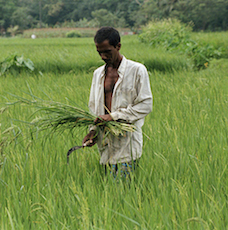


Flood Tolerant Rice: Managing Production Risk in the Philippines
As part of a new series of practical case studies showing agricultural risk management in action, this post highlights the use of a flood resistent rice variety to reduce the impact on agricultral production from one of the most pervasive agricultural risks in the Philippines.
Rice is one of the world's most important crops. One fifth of the world's population, more than one billion people, depend on rice cultivation for their livelihoods. And, for 520 million people in Asia, most of them poor or very poor, rice provides more than half of their caloric intake.
What's the Risk?
Rice is very vulnerable to climate, and in particular to the risk of flooding. Throughout Asia, the annual occurrence of flash floods and typhoons results in heavy production losses in paddy rice. In the Philippines, farmers experience high risk of crop losses (40-80%) during the typhoon month of October, November and December.
Risk Management with Resistant Seeds:
Because of the major threat that floods pose to production, the Philippines funds research, provides improved seed varieties, and promotes the use of submergence tolerant rice by rice farmers. These efforts which comprise the Philippine National Rice Program make up one of the most ambitious programs in the world geared toward reaching rice self-sufficiency by increasing production.
The challenging posed by frequent flooding in the Philippines can be mitigated without need for investing in additional the land preparation and other inputs. The flood tolerant rice variety NSIC Rc-194 (IRRI) survives, grows, and develops even after 10 days of complete submergence at vegetative stage. The use of NSIC Rc-194 has enabled farmer cooperators to produce acceptable rice yield under above stagnant water conditions, during the 2nd and 3rd crop seasons.
The Philippine Seed Industry Council (NSIC) first approved the release of a flood tolerant rice variety in 2009. NSIC Rc194, also known as Submarino 1, is IR64 infused with a submergence tolerance gene that was discovered by the International Rice Research Institute (IRRI) and the University of California-Davis from an Indian rice variety, FR13A. IRRI works closely with the Department of Agriculture, the Philippine Rice Research Institute (PhilRice), and other partners to upscale potential new rice varieties. These varieties are tested to make sure that they suit specific conditions in the country, ensuring wide-scale adoption by farmers. In total, 101 IRRI-bred varieties have been released thus far in the Philippines suited to irrigated, rainfed, upland, low-temperature, and saline environments.
A recent impact assessment study showed that over the past 25 years, Filipino farmers have gained an additional Php2,300 (US$52) per hectare from using improved IRRI-bred rice varieties.
The use of NSIC Rc-194 has enabled farmer cooperators to produce acceptable rice yield under above normal rainfall conditions, during the 2nd and 3rd crop seasons in 2010/11. NSIC Rc-194 variety was able to tolerate the La Niña effects (i.e., above normal precipitation) from December 2010 - March 2011. Under submerged conditions the average yield amounted 2.5 tons per hectare and the growing cycle included 125 days. Under normal conditions the variety even yields 3.50 tons per hectare and matures within 112 days (PhilRice 2009). The variety’s other characteristics in which farmers were interested besides the submergence tolerance, were: high milling recovery (65%), good eating quality, and better yield adaptation under rainy-environment.
Since its release, Submarino rice has been widely adopted by rice farmers across the Philippines thanks to efforts by the DA and its agencies, which have been actively promoting Submarino rice to farmers. Their effective strategies have included involving farmers in early field trials and seed multiplication efforts across the country alongside information, education, extension, and communication campaigns and materials.
The Submarino rice varieties currently available in the Philippines include Submarino 1 (NSIC Rc194, released 2009) and Sacobia (PSB Rc68, released 1997). Seed for these varieties can be obtained by contacting PhilRice or the IRRI, which can also provide starter seed packs. Under the current scheme in place, the DA has committed to provide seeds and crop insurance coverage worth P10,000 per hectare, and a total of P100 million has been allotted for crop insurance payments.