

FARMD Webinar Library
How Agricultural Data Flows Are Evolving Globally
The FARMD Webinar Series returns in 2016 with a new presentation on agricultural data flows and implications for managing agricultural risks. Mark your calendar for January 28th, and register below.
The webinar How Agricultural Data Flows Are Evolving Globally will be hosted in collaboration with Map of Agriculture. On Thursday, January 28th, 2016 from 9:00 am EDT to 10:00 am EDT, CEO Forbes Elworthy of Map of Agriculture will discuss agricultural data flows, highlight potential risk management solutions, and answer questions during a one-hour webinar presentation.
Data-Driven Agricultural Development, Presentation by Arable CEO Adam Wolf
 FARMD (November 24th, 2015) | The availability of national weather data in the developing world has dropped to near zero in many places, because the equipment is expensive to install and maintain and because the data is offline once it has been logged. The high costs are driven by many factors, including the cost of the sensing itself, the shipping, the scaffolding to hold it, the education needed to configure it, the need to send personnel to collect the data manually. But while weather data is important, data on crop productivity and soils is in many ways more critical for the agricultural value chain, and even more scarce. >> Learn More. >> Download the PPT >>Listen to the Webinar
Adam Wolf discussed how his company, Arable, aims to address some of these challenges. Arable is an integrated measurement and communications platform that addresses these data challenges. The platform is designed to be low cost, self-powered, and easy to install and maintain even in challenging environments. >>Learn More about the Speaker.
Presentation of the "Uganda Risk Assessment Study" by the Platform for Agricultural Risk Management
 FARMD (November 11th, 2015) | The Platform for Agricultural Risk Management (PARM) is working in strategic partnership with NEPAD/CAADP to mainstream risk management policies and tools into the agricultural investment plans of 9 African countries. The Risk Assessment Study on Uganda was launched on the 28th of October in Kampala on the occasion of the Commemoration of the African Day on Food and Nutrition Security. This webinar presented the methodology and results of this study and gave the opportunity to discuss the main findings with the authors. >>Download the Material related to the Study >>Download the PPT >> Listen to the Webinar
A team consisting of Jesús Antón, Senior Programme Manager for the Platform for Agricultural Risk Management (PARM), Jan Kerer (International consultant), Hebert Talwana (Makerere University), and Charles Mukama (Ministry of Agriculture, Animal Industry and Fisheries in Uganda) presented the Uganda Risk Assessment Study and answer questions during a one-hour long webinar presentation.
Overview of the Technical Training Program "Agriculture Sector Risk Assessment" by Åsa Giertz, Agricultural Specialist, World Bank's Agricultural Risk Management Team
 FARMD (November 5, 2015) | The World Bank has synthesized its experiences conducting risk assessments and has developed the Technical Training Program "Agriculture Sector Risk Assessment" to allow practitioners around the world to apply this methodology and integrate it in general agricultural policy work. The training program was originally introduced as a two-day training in Johannesburg, South Africa, in May 2015. The program includes core principles for assessing agricultural risks, as well as current state-of-the-art practices in risk assessment and management. >>Download the Training Material >>Download the PPT
Åsa Giertz, Agricultural Specialist with the World Bank's Agricultural Risk Management Team, will gave an overview of the Technical Training Program on "Agriculture Sector Risk Assessment" and answered questions during a one-hour long webinar presentation.
Paraguay Agricultural Sector Risk Assessment: From Identification to Action Plan, presentation by Vice Minister of Agriculture of Paraguay Mr. Mario León
 FARMD (September 30th, 2015) | Accounting for 30% of its GDP and 40% of its exports, agriculture is a key sector of the Paraguayan economy. Thus agriculture risks have extensive repercussions on economic growth, public finances, and the development of agriculture supply chains and rural poverty. Paraguay losses approximately $237 million on average every year, or 5.4% of agriculture GDP, due to production risks that could be managed along the main agriculture supply chains. Following a request by the Government of Paraguay, the World Bank conducted the Agricultural Sector Risk Assessment in Paraguay (Download the PDF). The study aimed at identifying, quantifying, and prioritizing agriculture risks, as well as proposing solutions for reducing the volatility of agriculture output and incomes of family farmers.
Vice Minister of Agriculture of Paraguay Mario Leon explained the lessons learned from the report and detail the challenges that have risen from operationalizing the plan. Diego Arias, Senior Agriculture Economist for the World bank provided some background on the agriculture risk assessment. >>Download the PPT Presentation
Building Resilience of the Agriculture Sector in Niger: Moving from Crisis Response to Long Term Risk Management, presentation by Dr Barkire (Governement of Niger) & Amadou Ba (World Bank)
 FARMD (August 27, 2015) | As a follow up to the Agricultural Sector Risk Assessment conducted by the World Bank in Niger, the Government of Niger developed, finalized, and launched a 10-year agricultural risk management action plan called the "Plan d'action pour la gestion des risques agricoles au Niger" (PAGRA) 2014-2023. Amadou Ba, Principal Agroeconomist at the Niamey's World Bank office introduced the topic and background of the Agricultural Sector Risk Assessment for Niger (PDF English version). Dr. Barkire, Technical Adviser for the National Strategy for Food Security and Agriculture Development called 3N Initiative ("les Nigériens Nourissent les Nigériens"), presented PAGRA, explaining the lessons learned so far and detailing the challenges that have risen from operationalizing the plan. The webinar presentation was held in French, followed by a Q&A session in both French and English. >> Learn More >> Read Dr. Barkire's interview to FARMD
ILSI Research Foundation and the Center for Integrated Modeling of Sustainable Agriculture and Nutrition Security, presentation by Dr. McLean and Dr. Gustafson
FARMD (May 6, 2015) | Dr. Morven McLean, the Executive Director of the International Life Sciences Institute Research Foundation (ILSI Research Foundation), and Dr. David Gustafson, the Director of the ILSI Research Foundation’s Center for Integrated Modeling of Sustainable Agriculture and Nutrition Security (CIMSANS) introduced the ILSI Research Foundation and the work it does regarding risk management, agriculture and food security. Emphasized the role of food systems, they explained how the nutritional content of food consumed contributes to the ‘nutrient’ security aspects of sustainable nutrition security. They further detailed the ILSI Research Foundation efforts to better quantify food system contributions to sustainable agriculture and nutrition security. >>Learn More. >>Download the presentation.
Managing Vulnerability and Boosting Productivity in Agriculture Through Weather Risk Mapping, presentation by C. Arce and E. Uribe from the World Bank's Agricultural Risk Management Team
 FARMD (April 8, 2015) | Carlos Arce and Edgar Uribe from the World Bank's Agricultural Risk Management Team presented the guide for development practitioners “Managing Vulnerability and Boosting Productivity in Agriculture through Weather Risk Mapping.”
Weather risk mapping for agriculture, or agro-meteorology risk mapping, is one way to manage weather risk. During the webinar, Carlos and Edgar presented an overview of existing mapping techniques for weather risk mapping and provide their insights on the suitability of techniques for designing weather risk management strategies in developing countries. >>Learn More. >>Download the presentation.
Risk Management Solutions for Emerging Agriculture, presentation by Dr. Raphael Karuaihe, Commodity Derivatives Manager at the Johannesburg Stock Exchange
 FARMD (March 18, 2015) | Agriculture is a risky business in which all farmers have to manage the risk of getting low prices for their products, also referred to as commodity price volatility. This challenge is greater for smallholder farmers who have limited financial reserves.
Dr. Raphael Karuaihe, a commodity derivatives manager at the Johannesburg Stock Exchange, explained how small farmers can protect themselves against price risk. Explaining the mechanisms and differences between futures contract, put options and standardized contracts, he discussed the specific challenges when working with small farmers. >>Learn More. >>Download the presentation.
The Renewal of Market Information Systems, presentation by Dr. Hélène Benz, Senior Agro Economist and Dr. Franck Galtier, Senior Researcher Economist at CIRAD)
 FARMD (March 4, 2015) | A special issue of Cahiers Agriculture entitled "The Renewal of Agricultural Market Information Systems (MIS) in Developing Countries" was published in January 2015. Following the publication, Dr. Hélène David-Benz and Dr. Franck Galtier, two researchers from the French public research institution CIRAD who contributed to the special issue, discussed the changing role of Agricultural MIS and the opportunities the development of information and communications technologies (ICT) have offered.
>> Learn More >>Download the presentation.
Strengthening and Enhancing Seed Systems to Better Manage Agricultural Risk, Webinar Presentation by Dr. Jill Cairns, Physiologist, Senior Scientist at the International Maize and Wheat Improvement Center (CIMMYT)
 FARMD (January 14, 2015) | Strengthening and enhancing seed systems is essential to ensure that farmers, the ultimate beneficiary of seeds, have access to newly released varieties and are connected to seed companies, one of the key players in the value chain. This is why CIMMYT scientists such as Dr. Cairns reserach on different drought tolerant maize varieties working with seed companies and farmers. Dr. Cairns presents her research and discuss the key constraints for having profitable, productive seed systems, and we can overcome these challenges.>>Learn More.
>>Download the presentation.
Climate Services for Smallholder Farmers, Webinar Presentation by Dr. Jim Hansen, IRI, Senior Scientist at Columbia University in New York City and CGIAR CCAFS
 FARMD (December 3, 2014) | Through the ages, farmers have used indigenous knowledge and traditional coping strategies to adapt to changes in weather and climatic conditions. Now, increasingly erratic climate variability is making it difficult for farmers to keep up. Easily accessible and timely scientific information can help societies not only limit the economic and social damage caused by climate-related disasters, but also take advantage of opportunities provided by favorable conditions. Climate services are meant to fill this need. They will ensure that the best available climate science is effectively communicated with agriculture, water, health and other sectors, to develop and evaluate mitigation and adaptation strategies. >> Learn More >> Download the presentation
Climate Change and Smallholder Agriculture in Sub-Saharan Africa, Webinar Presentation by Dr. David Ameyaw, AGRA
 FARMD (October 9, 2014) | FARMD Annual Conference keynote speaker Dr. David Ameyaw of the Alliance for a Green Revolution in Africa (AGRA) led a webinar discussing the findings of AGRA's African Agriculture Status Report 2014.
The report provides a comprehensive analysis of emerging challenges facing smallholder farmers in Sub-Saharan Africa and highlights areas where investments in African agriculture have the potential to be most productive. >> Learn More >>Download the presentation
World Bank Supply Chain Risk Assessment Training, Webinar Presentation by Dr. Choudhary and S. d'Alessandro, World Bank Ag. Risk Management Team (September 24th, 2014)
 FARMD (September 24, 2014) | Developed by the World Bank, this training program is a "how-to" guide for conducting Supply Chain Risk Assessments (SCRA). It captures the experience and examines lessons learned since 2009 from analyzing risks to agricultural commodity supply chains in developing countries across Africa, Latin America and Asia.
More specifically, the training provides step-by-step guidance for development practitioners on how to best leverage SCRA as a tool for assessing critical risks and promoting evidence-based decision-making for improved supply chain risk management. >>Course materials are available here.
Cocoa Sector Development in Latin America and the Caribbean: Challenges, Risks, and Roles for the Public and Private Sectors
 FARMD (March 26, 2014) | Global demand for cocoa is growing and this is seen as good news for thousands of small farmers throughout Latin America and the Caribbean (LAC). The region expanded its share of world cocoa production in recent years, reaching an estimated 15.7 percent in 2012-2013. However, there are significant challenges associated with the management of agricultural risks in cocoa production and marketing, including: the incidence of pests and diseases, price volatility, and climate variability, among others. These growing challenges and risks must be effectively addressed to ensure that the sub-sector can effectively generate prosperity for thousands of farming families in the region.
From Catastrophic to Shallow Loss Coverage: An Economist's Perspective of U.S. Crop Insurance Program and Implications for Developing Countries
 FARMD (November 20, 2013) | The U.S. crop insurance program is unusual among U.S. agricultural programs in that it is delivered by the private sector. Insurance companies and agents sell and service policies that are obtained by producers. Insurance companies and agents compete in a highly regulated market for producer insurance business. The companies earn underwriting gains and receive administrative and operating subsidies and reinsurance on policies sold. This presentation will examine the U.S. crop insurance experience with a focus on the incentives to producers and to private insurance companies. >>Learn More
Aflatoxin Risk Management in Agricultural Supply Chains
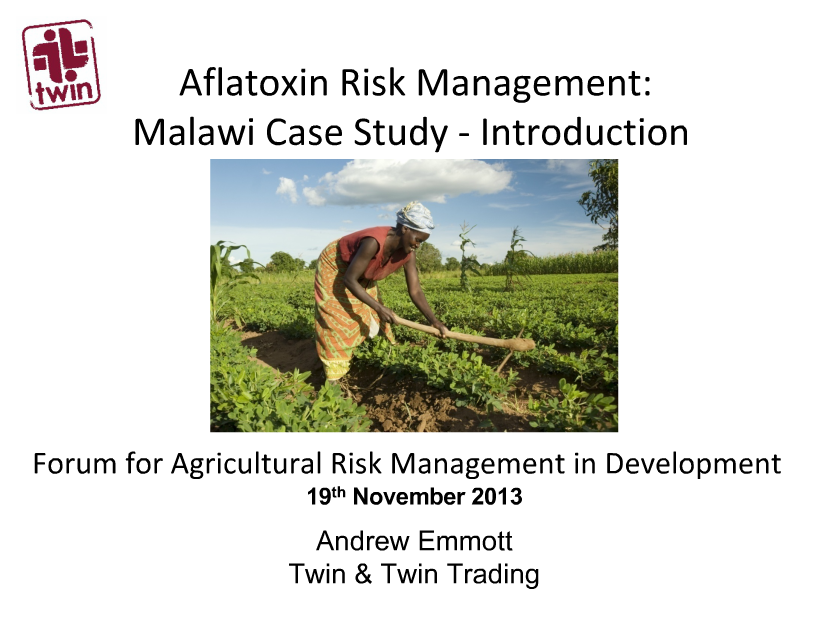 FARMD (November 19, 2013) | Aflatoxin contamination of crops, and the consequent health impacts to humans and animals, is one of the most complex global agricultural risk management challenges we face today. In recent years, a pan-African initiative has emerged, the Partnership for Aflatoxin Control in Africa (PACA), which is managed by the African Union through CAADP. This webinar explores the approach taken by Malawi, through the Malawi Programme for Aflatoxin Control (MAPAC), to develop a framework aligned to PACA that seeks to address the challenges of monitoring, managing and mitigating aflatoxin risks in maize and groundnuts. >>Learn More
Extension and Advisory Services Capacities to Deal with Risk: The “New” Extensionist
 FARMD (October 17, 2013) | Small-scale agricultural production has always been a risky business. What do extension and advisory services (EAS) have to do with agricultural risk and risk management options? Extension and advisory services play an important role in agricultural development for food and nutrition security, food sovereignty, and economic stability. They help smallholders deal with risk and change. However, advisory services need new capacities to address today’s challenges in agriculture and to contribute better to agricultural innovation – a process that that requires interactions and knowledge flows among a wide range of actors in the agricultural innovation system. Innovation is critical to dealing with risk. >>Learn More
Loss adjustment in Agriculture: Key principles of building an effective system
 FARMD (September 17, 2013) | Building an effective system of risk and loss adjustment is extremely important for both insurance and banking industries. International experience provides various examples of different approaches to loss adjustment. Some examples are more effective, some less. Although, the importance of well-organized loss adjustment system is hard to argue. This webinar will review loss adjustment models from different countries and will identify key elements from each that can used when building a new, or changing an existing system. We will also present an innovative model that is currently being introduced and developed in Ukraine, which is yielding positive results. The sample model that we will discuss could be used and applied in most countries of the world. >>Learn More
Getting Ahead of the Crop Pest Epidemic Curve
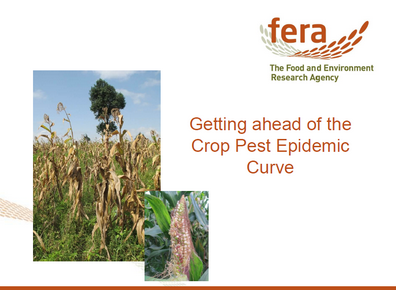 FARMD (May 21, 2013 ) | The aim of the webinar was to propose a collective responsibility to deliver a step-change in our capacity to recognize and respond to emerging crop pest threats, so as to mitigate current and future epidemics, notably of the developing world and particularly in Africa. Through its partners Fera, CABI, IITA and the current chair of the CPM to the IPPC, the webinar gave voice to the need for investment in crop pest epidemic mitigation as an essential precursor to resilient cropping and food systems. Whilst focused on developing countries, the overriding message is about strengthening the global capacity in risk analysis, prevention, surveillance, and response to crop pest threats in providing for global food security as a one-world challenge. >>Learn More
Managing Agricultural Price Instability
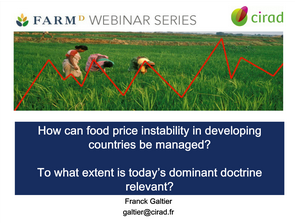 FARMD (May 7, 2013) | Based on an extensive review of the theoretical and empirical literature, this webinar will provide a critical assessment of the dominant thinking surrounding the management of agricultural price instability as applied to grains. Using the case of Mali, it will be asserted that current thinking substantially underestimates (i) the magnitude of price instability generated by grain markets, (ii) the degree to which farmers and consumers in developing countries are exposed to this instability, and (iii) the resulting effects on welfare (including macroeconomic and long-term consequences). >>Learn More
Climate Change and Food Production in China
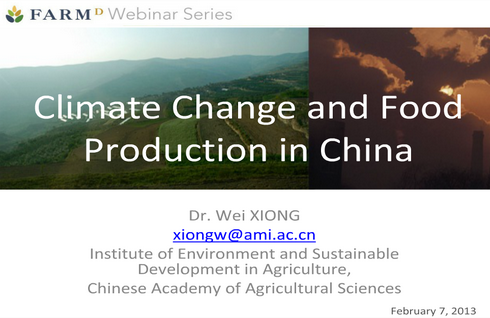
FARMD (February 7, 2013) | Dr. Wei Xiong presented on the topic of "Food Production and Climate Change in China," touching on the issues of why we should be concerned and how climate change will potentially affect food production in China in both the short- and long-term future. >>Learn More