Home
Advanced Search
Join FARMD
  • Home
  • FARMD
    • Overview
    • History, Support, and Organization
  • Ag-Risk Management
    • Basic Concepts
    • Risks and Exposures
    • Risk Management Options
    • Reduction, Mitigation & Transfer
    • Lexicon of Terms
    • FAQs
  • Resources
    • News & Features
    • Featured Topics
    • Events
    • Training Materials
    • FARMD Library
    • FARMD Webinars
    • Practitioner Directory
    • Practitioners in Action
    • 2014 Conference
      • Conference Home
      • Conference Agenda
      • Moderator Profile
      • Speaker Profiles
      • Conference Material
    • 2012 Conference
      • Risk and rice in Asia
      • Conference Agenda
      • Conference Multimedia
      • Speaker Profiles
    • 2011 Conference
      • Conference Home
      • Speakers Profile
      • Material on Price Volatility
      • Material on Climate Variability & Insurance
  • Risk Assessment
  • Resilient Supply Chains Dialogue
  • Contact Us
Agriculture Sector Risk Assessment
 
  • Summary
  • Brazil
  • Ghana
  • Kenya
  • Malawi
  • Mozambique
  • Niger
  • Paraguay
  • Rwanda
  • Senegal
  • Tanzania
   
Sign Up for Email Updates
For Email Marketing you can trust.

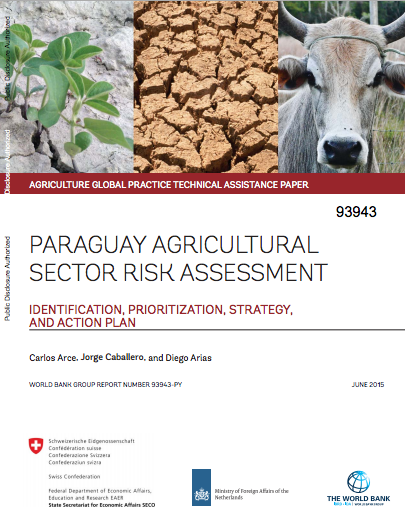
Paraguay Agricultural Sector Risk Assessment : Identification, Prioritization, Strategy, and Action Plan

Given that agriculture is a key sector of the Paraguayan economy, accounting for 30% of gross domestic product (GDP) and 40% of exports, it is evident that agriculture risks have repercussions on economic growth (and its exports), public finances, and the development of agriculture supply chains and rural poverty. Paraguay losses approximately $237 million on average every year, or 5.4 percent of agriculture GDP, due to production risks that could be managed along the main agriculture supply chains. Given the nature of the impacts and dimension of losses in the agriculture sector, it is clear that there is ample room to undertake investments in risk management programs. 

In June 2013, the World Bank's Agricultural Risk Management Team, following a request by the Government of Paraguay, identified, quantified, and prioritized agriculture risks, proposing solutions for reducing the volatility of agriculture output and incomes of family farmers. 

Entitled Paraguay Agricultural Sector Risk Assessment: Identification, Prioritization, Strategy, and Action Plan (PDF English version), or Análisis de riesgo del sector agropecuario en Paraguay : identificación y priorización de los riesgos agropecuarios (PDF Spanish version), the risk assessment provides: 

  • Information about the agriculture sector and its recent performance, allowing to determine the most important supply chains for this risk assessment and to place the relative economic and social importance of the various commodities and production methods in context.
  • A comprehensive assessment of production, market, and enabling environment risks for the main commercial and family farming supply chains, in addition to livestock;
  • Information about the repercussions that risks have had in the past, in particular, aggregated losses incurred by supply chain actors.
  • An assessment of the impacts of these losses throughout the supply chains and of the relative vulnerability of the different actors.
  • The results and ranking of risks, and a list of possible solutions to address such risks. 

As a follow up of ARMT work, the Government has expressed keen interest to implement the recommendation of the action agenda set during the solution assessment phase. The World Bank is currently under discussion with the Government of Paraguay to plan next steps for implementing the action agenda. A Policy Note summarizing the report's key findings is available here.


Summary of the Report


Risks Identification & Prioritization

Ag Sector Risk Assessment in Paraguay

  • Production risks are the most frequent and of greater impact in the agriculture sector of Paraguay. The most notable one, given global magnitude of losses, is drought. 
  • Pests and diseases also impact production, although in general, they do not represent the main risks. 
  • The animal health problems like the foot and mouth outbreaks have had catastrophic economic consequences.
  • Prices of agriculture products from family farms, like sesame and cotton, are subject to high volatility, which is directly transmitted to producers.
  • Enabling environment risks are important for the agriculture sector of Paraguay, in part given its landlocked situation and for the past weaknesses of public investments in basic infrastructure and technology. 

The distributional impact of risks throughout the supply chains varies. The stakeholders most affected tend to be the producers, and the final result is often an increased indebtedness and the reduction in investment capacity. The rural poverty situation of Paraguay (almost half of the rural population is poor) is intrinsically connected to the vulnerability to agriculture risks

Risk Management Strategies

Paraguay Agricultural Risk Assessment Report Spanish

The Government of Paraguay is implementing a series of programs and projects that address resilience problems and many of the identified risks. Given these current programs and projects, the proposed strategy intends to tackle risks in an integrated manner through better management and with the objective of reducing rural poverty and increasing the resilience of family farms.

  • The best risk management for family farmers is proposed through the development of a more efficient and coordinated Agriculture Innovation System, and through a mechanism for compensating incomes in case of extreme weather contingencies. 
  • With respect to animal health risks, the strategy includes measures for protection of export markets and for improving the country’s sanitary conditions and safety of food products.
  • The strategy also proposes the development of an Agriculture Commodity Exchange to mitigate and eventually transfer market risks, among other objectives.
  • The proposed measures are not easily implemented and require a concerted effort between public and private sectors.
  • A series of policy measures were identified as essential to achieving an appropriate agriculture risk management framework and to put into practice the preceding mentioned actions. 

 Terms of Use    Privacy Policy    Legal

© 2014 Forum for Agricultural Risk Management in Development