
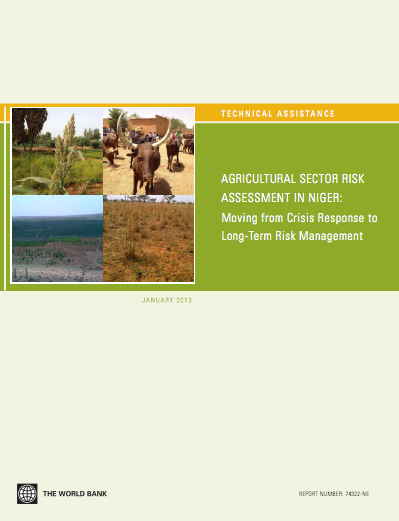
Agricultural Sector Risk Assessment in Niger: Moving from Crisis Response to Long-Term Risk Management
 Due to the climatic, institutional, economic and environmental contexts, Niger is one of the most vulnerable countries in the world. Agriculture is the most important sector in the country, accounting for the livelihood of 80% of the country’s population and 40% of country’s gross domestic product (GDP). The performance of the agriculture sector is clearly critical for economic development and food security in Niger, however, the sector is extremely volatile due to a high exposure to risk and frequent shocks.
Recognizing the need to explicitly and comprehensively address these agricultural risks, the Government of Niger, through the 3N High Commissioner requested the World Bank to conduct an Agricultural Sector Risk Assessment for Niger (Download PDF in English) / Evaluation des Risques du Secteur Agricole au Niger : De la Réaction aux Crises à la Gestion des Risques à Long-Terme (Télécharger PDF version française). This risk assessment took place in March 2012 and provides:
|
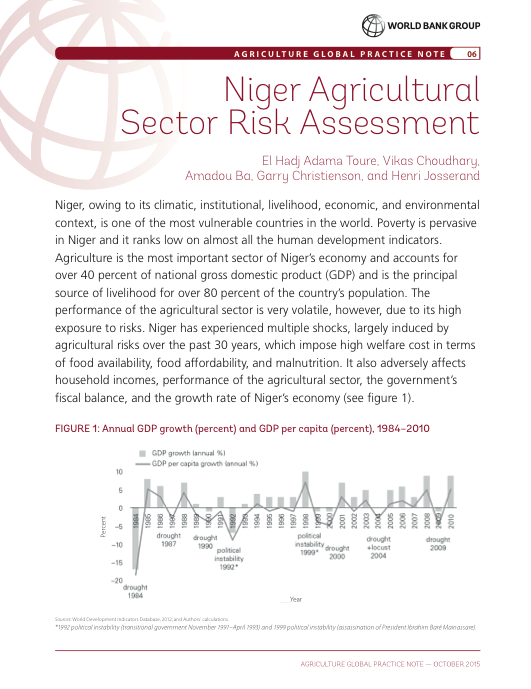
Key findings of the reports were summarized in the Niger Agricultural Sector Risk Assessment Policy Note (Download PDF).
As a follow up of ARMT work, the Government of Niger developed, finalized, and launched a 10-year agricultural risk management action plan: the "Plan d’action pour la gestion des risques agricoles au Niger" (PAGRA) 2014-2023. Since 2012, the World Bank has continued to provide technical support to the 3 N High Commission towards refinement and finalization of PAGRA.
In August 2015, Dr. Barkire (Technical Adviser for the 3N Initiative), and Amadou Ba (Principal Agroeconomist at the Niamey's World Bank office) gave a webinar presentation on PAGRA, explaining the lessons learned so far, and detailing the challenges that have risen from operationalizing the plan. Entitled Building Resilience of the Agriculture Sector in Niger: Moving from Crisis Response to Long Term Risk Management, you can download the presentation and replay the webinar here.
Summary of the Report
Interconnected RisksDrought was identified as the principle risk in Niger, with seven droughts occurring in the country between 1980 and 2012 – all with adverse impacts on the agricultural sector. Drought was discovered to be a trigger of many other significant risks. For example, drought is the principal trigger that leads to sudden spikes in commodity prices, and also creates fodder scarcity, thereby contributing to and intensifying conflict risk between herders and farmers, as well as making animals more susceptible to diseases. In addition, fodder scarcity during drought forces birds and grasshoppers to move to cultivated areas, causing severe damage to mature crops. Interdependencies between different risks need careful attention to ensure that the combined problem, rather its separate symptoms, is being addressed. Risk PrioritizationThe analysis specifically highlights six main priority areas: (1) drought (crops), (2) Drought (livestock), (3) locust outbreaks, (4) consumer price risk, (5) livestock diseases, and (6) political instability. Risk Management & Relative Benefits of Risk Management MeasuresBased on prioritization of risk and intervention measures, the following six interventions might yield greatest risk management benefit:
ConclusionNiger is a case of living perpetually with risk, thus more emphasis on long-term structural solutions, rather than short-term quick fixes, is required to improve the resilience of the agricultural sector. Designing and implementing a comprehensive agricultural risk management strategy will require sustained and substantial financial investments, shifting the focus from short-term crisis response to long-term risk management, streamlining disparate donor investments and isolated interventions toward the core problem, supporting decentralized community- and farm-level decision making, integrating agricultural risk management into the existing development frameworks, prioritizing agricultural risks into government and donor strategies, and focusing on implementation. |