
Mozambique: Agricultural Sector Risk Assessment
 Agriculture accounts for 31.8% of Mozambique gross domestic product (GDP), providing a livelihood to almost 81% of the labor force. The majority of production undertaken by smallholder farmers is for consumption, and the main staple crops produced are maize, sorghum, rice, millet, potatoes, sweet potatoes, cassava, and beans. Many family farms combine food crops with a single cash crop. The majority of Mozambican agriculture is rain fed and therefore very sensitive to climatic conditions. Climate change models indicate an increased likelihood of extreme weather events such as flood, drought, and cyclones leading to severe negative impacts on the agricultural sector in Mozambique.
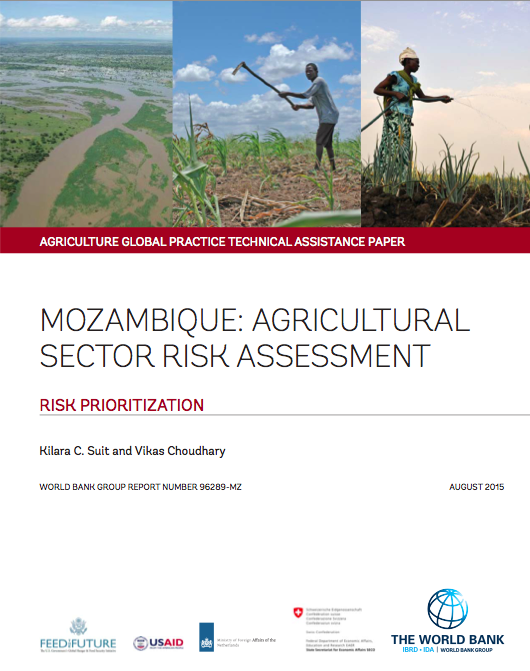
Recognizing the need to explicitly and comprehensively address these weather-related agricultural risks, the Group of Eight’s (G-8) New Alliance for Food Security and Nutrition requested that the World Bank conduct an Agricultural Sector Risk Assessment for Mozambique (Download PDF), with the following objectives:
|
This risk assessment took place in 2013 and provides:
- An introduction and sets the context for Mozambique’s agricultural system and agricultural sector risks;
- A quantification of losses and impact of agricultural risks in the country;
- Several stakeholder risk assessments and commodity risk profiles;
- Risk prioritization and management solutions.
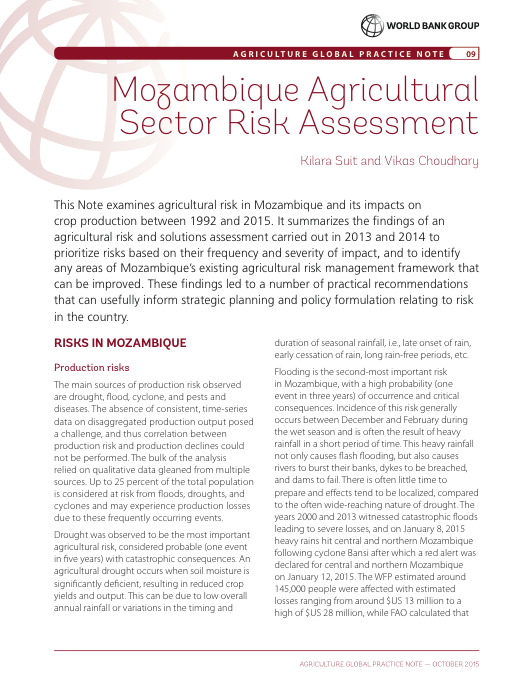
Key findings were summarized in the Mozambique Agricultural Sector Risk Assessment Policy Note (Download PDF).
Summary of the ReportThe periods of intense civil war (1985–86 and 1990–92), drought (1994), and flood (2000) resulted in negative growth rates in the agricultural sector. Since 2000, the growth rate has not dipped into negative territory, but the occurrence of agricultural risk has had an adverse impact on agricultural growth. The frequent occurrence of agricultural risks creates food affordability and availability problems for vulnerable rural populations and urban consumers, and results in sudden spikes in the food insecure population. Risks Identification & Prioritization1. Production Risk: The main sources of production risk observed through analysis of data and interviews with a range of farmers and other stakeholders are drought, flood, cyclones, and pests and diseases. 2. Market risks: Price volatility (domestic as well as international), exchange rate volatility, input volatility, and counterparty risk are some of the major market risks in Mozambique. They, however, are less significant than production risks, and in many instances, crop failure caused by production risks triggers price spikes in local markets. Abrupt and steep price spikes and falls, often driven by underlying production deficits, market factors, or other exogenous factors, are a cause of serious concern with severe implications for consumers and producers alike. 3. Enabling environment risks: Enabling environment risk covers many different aspects of legal, institutional, fiscal, and policy volatility and/or uncertainty that affect stakeholders’ ability to conduct their business within a sector. In Mozambique, the enabling environment is relatively weak, but stable, and thereby is not much of a risk for the agricultural sector. Conflict and insecurity, political instability, and regulatory risk can have an adverse impact on the agricultural sector. Risk Management StrategiesBased on the assessment team’s evaluation, which combined qualitative and quantitative analysis, drought and flood emerge as the two biggest agricultural risks in Mozambique. These are followed by pest and disease outbreaks, international price volatility, and domestic price volatility, which are often difficult to quantify. To address the priority risks, the assessment deployed a holistic agricultural risk management framework, composed of mitigation (action taken to reduce the likelihood of events, exposure, and/or potential losses), transfer (risk transfer to a willing party, at a fee or premium), and coping solutions (activities geared toward helping cope with losses) to identify a list of potential interventions. Risk mitigation is perhaps the most needed, and the most ignored risk management component, with the highest returns in addressing short- and long-term risk issues in Mozambique’s agricultural sector. Based on the prioritization of risk and intervention measures, the following three intervention categories might yield greatest risk management benefits:
These three intervention categories align with PNISA and PEDSA, and many of them are being implemented and are having positive impacts, albeit at a smaller, localized level. Greater emphasis should be placed on scaling up these interventions to the national level to make a meaningful impact on the agricultural sector in Mozambique. |