Agricultural Sector Risk Assessment
More productive, more resilient, and more sustainable agriculture now tops the post-2015 development agenda. The 2030 Agenda for Sustainable Development calls for “sustainable food production systems and resilient agricultural practices that “increase productivity and production, that help maintain ecosystems, that strengthen capacity for adaptation to climate change, extreme weather, drought, flooding and other disasters and that progressively improve land and soil quality.” These goals more than ever are within reach, yet reaching them will require new and better ways of tackling agricultural risks.
To promote a better understanding of agricultural risks and identify effective pathways to improved risk management, the World Bank has developed a conceptual framework– the Agricultural Sector Risk Assessment (ASRA). The ASRA is a step-wise approach to identifying, assessing and prioritizing risk for improved targeting of risk management solutions. The ASRA framework outlines an analytical approach to assessing risks from an integrated and holistic perspective. It is designed as a decision support tool to assist governments, the private sector and other agricultural stakeholders in developing countries to:
- better comprehend the complexity of agricultural risks;
- develop and implement appropriate and targeted risk management strategies (i.e., mitigation, transfer, coping) that can strengthen the resilience.
Understanding the dynamics of risks and which risks have the greatest impact is fundamental to designing effective risk management strategies. For this reason, ASRA measures the frequency of risk events and associated financial losses using a broad mix of quantitative and qualitative data, the latter collected directly from stakeholders. It also assesses levels of vulnerability—or the capacity to manage or cope with risks—among various stakeholder groups. Through this quantification process, ASRA highlights which risks are most debilitating to sector stability and growth and therefore merit a stronger, more direct risk management response. More broadly, the assessment process is intended to increase the awareness of potential risks that may undermine development strategies; build the capacity of government decision makers to identify and prioritize risk management solutions; and initiate a process to integrate these findings into planning and budgets.
The World Bank is currently developing a Guidelines document on how to conduct ASRA, which will soon be published for broad public dissemination on the FARMD websites.
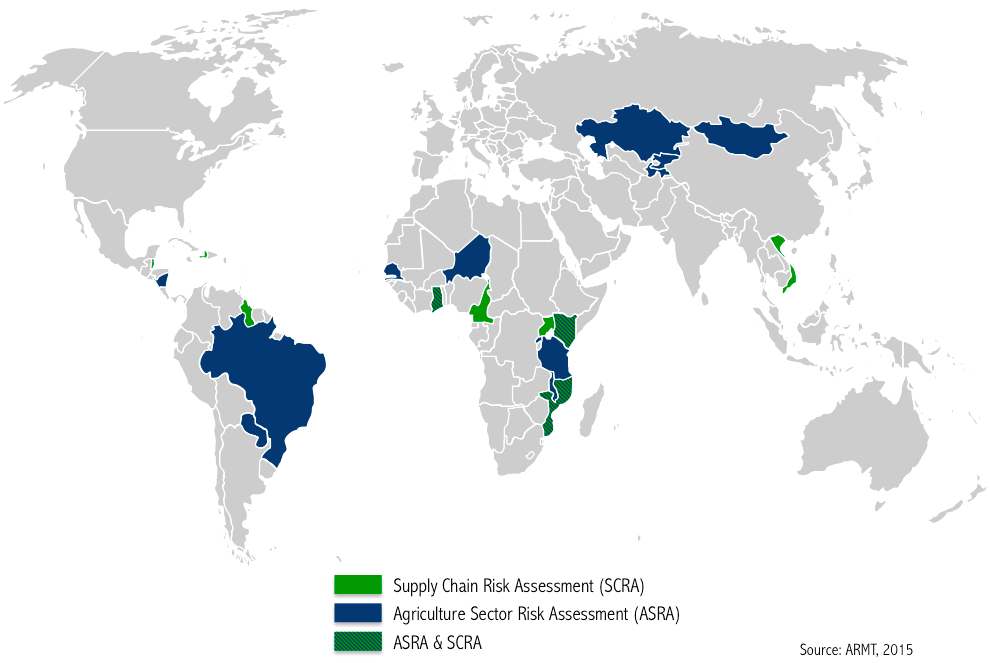
Since 2009, the World Bank has conducted risk assessments with stakeholders in nearly 20 countries across Africa, Asia, Latin America and the Caribbean, including Agriculture Sector Risk Assessments (ASRA) and Supply Chain Risk Assessments (SCRA), which are based on the same methodology.
- ASRA countries include Brazil (at subnational level, in Bahia and Paraíba states), Kenya, Ghana, Kazakhstan, Kyrgyzstan, Malawi, Mongolia, Mozambique, Nicaragua, Niger, Paraguay, Rwanda, Senegal, Tajikistan, Tanzania, Uganda, and Vietnam.
- SCRA countries include Belize, Grenada, Haiti, Mozambique, Guyana, Cameroon, Uganda, Vietnam, Ghana, and Kenya.