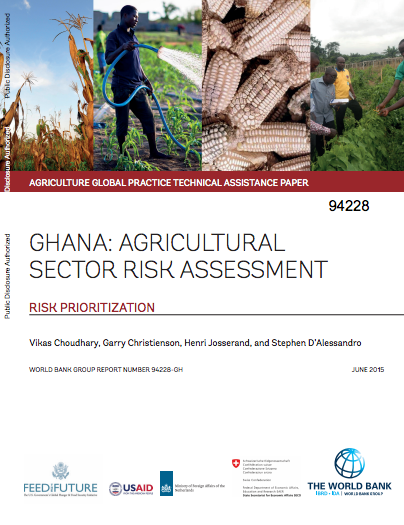
Ghana: Agricultural Sector Risk Assessment
In Ghana, the agricultural sector remains a backbone of the economy. Nearly two decades of productivity growth, beginning in the early 1990s, has helped put Ghana back on a path to recovery following more than a decade of economic uncertainty. With the exception of millet and sorghum, output for most crops has increased at a faster rate than population growth.
Sustaining the sector’s growth trajectory is a top priority for the recently elected administration of President John Dramani Mahama. Success will depend, in part, on the government’s ability to manage the country’s ongoing transition to a more diversified economy while ensuring that the country’s smallholder farmers, food processors, and other sector actors have what they need to remain competitive. It also hinges upon the ability of all stakeholders to recognize, respond, and adapt to a changing landscape: one characterized by climate change, increasing weather variability, increasing threats from pests and diseases, and higher food price volatility, among other risks. The catastrophic flooding of 2007 and more recent food price shocks served as stark reminders of the importance of effective risk management.
In 2014, the Agricultural Risk Management Team (ARMT) of the Agriculture and Environment Services Department of the World Bank conducted the Ghana Agricultural Sector Risk Assessment (PDF) to better understand the dynamics of agricultural risks and identify appropriate responses, incorporate agricultural risk perspective into decision-making, and build capacity of local stakeholders in risk assessment and management.
ARMT work in Ghana provided a valuable analytic lens for the Government and development partners to prioritize activities and develop longer term action agenda for risk management. The minister requested continued support from the World Bank to consider how to operationalize the recommendations of the assessment.
Summary of the ReportRisks Identification & Prioritization 1. The analysis shows that although risk is a permanent feature of agriculture in Ghana, its impact on output and growth is relatively low at the broader, sector level. Certain inherent strengths (diversity of agro-climatic conditions, of production systems, and of the crops and seeds used within those systems) reduce the sector’s overall vulnerability to risk while limiting associated losses. 2. Disaggregated analysis by region and by crop showed a higher frequency of adverse production and price events. Adverse events occur in most years for some regions and commodities, and are usually off set by above-trend production in other regions and other crops, reducing the overall impact of risk. 3. Whereas the adverse impact of agricultural risk at the broader sector level is low, its frequent occurrence causes significant income volatility, especially for low-income rural households engaged in rain-fed agriculture. 4. Multiple shocks cause the greatest losses, particularly when they are precipitated by drought or other weather-related risk events. 5. Low-income, rural households, especially in the northern regions, are most susceptible to production and price shocks. Regional risk analysis further showed that Upper East, Upper West, and Northern regions are most prone to drought and flooding, whereas the Eastern Region is susceptible to fluctuations in maize and cassava production. 6. Given Ghana’s heavy reliance on rain-fed agriculture, drought causes the highest level of cumulative losses with the greatest impact on livelihoods, particularly in the northern savannah zones. 7. Posing a constant threat to both crops and livestock, pests and diseases constitute the second most important production risk after drought. Cassava, cocoa, and plantain are among those crops most susceptible to attack. However, current control measures, in some cases with cocoa and cassava, have been relatively effective. 8. Price volatility poses the most important market risk facing agricultural stakeholders. This is especially true for maize; growing maize exports in recent years have contributed to higher levels of price volatility in domestic food markets. In addition, plantain, cassava, and yams are among the crops most susceptible to adverse impacts from price variability. 9. Among enabling environment risks, the assessment calls attention to concerns over weak capacity among state-level institutions, including the Ghana Cocoa Board and the National Disaster Management Organization, tasked to manage and respond to the most important risks facing the agricultural sector. Risk Management StrategiesThis assessment off ers the following preliminary recommendations for consideration: 1. Promoting improved farming practices (for example, integrated pest management, or IPM), especially in the south, and conservation agriculture measures (especially in the north). 2. Strengthening improved seed (that is, drought, pest, and disease resistant) development and distribution systems. 3. Upgrading information systems to ensure availability of timely and relevant weather, prices, and pest and disease information to farmers, traders and other stakeholders, coupled with relevant technical advice and knowledge. This also includes market information about production, stocks, and trade of different commodities. 4. Promoting improved water management (for example, soil and water conservation measures) and irrigation (especially micro-level) and drainage infrastructure (especially, in flood-prone areas). 5. Strengthening extension systems (for example, face-to-face, information communications technology based, peer to peer) to ensure that farmers have better access to technology, agronomic advice, and other resources needed to put in place new mitigation measures and improve existing methods. 6. Improving infrastructure (on-farm and off -farm storage, warehouses, roads, and so on) to improve productivity, reduce post-harvest losses, and help manage the risk of price volatility. 7. Considering recent news about phased withdrawal of COCOBOD from a centralized disease control system and its potential consequences on pest and disease outbreak and cocoa production, a more systemic approach of pest and disease management is required to:
|