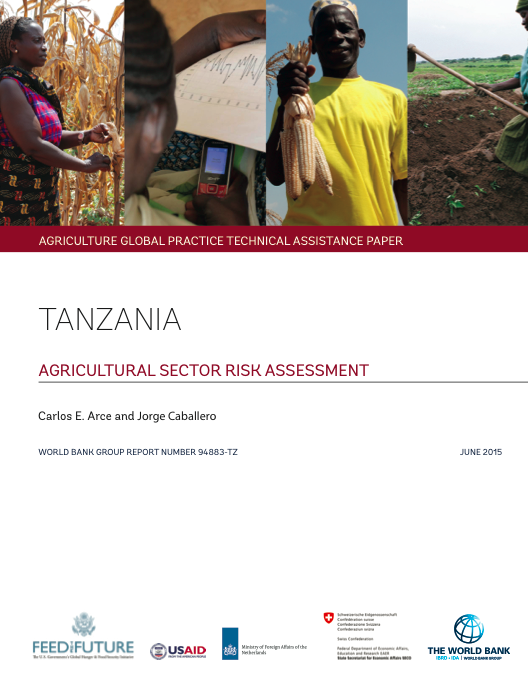
Tanzania: Agricultural Sector Risk Assessment
In spite of Tanzania’s comparative advantage in the production of many crops (cashew nuts, coffee, cotton, tea, tobacco, maize, and rice, for example) and the relative abundance of natural resources, 38% of the rural population, or 13 million rural inhabitants, live below the poverty line. The agricultural gross domestic product grew at an annual average rate of 4% between 2005 and 2012, which is significant but below the 6% considered necessary for reducing poverty. Most small-scale farmers in Tanzania still continue to use low, purchased-input technologies that result in poor yields and scanty economic returns while facing high production price volatility and limited incentives to invest.
As a follow up of the Agricultural Sector Development Strategy developed by the Government of Tanzania in 2001, and in which the key constraints to achieving agricultural growth targets, among them “un-managed risks with significant exposure to variability in weather patterns with periodic droughts” are highlighted, the World Bank's Agriculture Risk Management Team conducted an Agricultural Sector Risk Assessment for Tanzania (Download the PDF).
This report comprises the first phase of the Agricultural Risk Assessment for Tanzania related to identification and prioritization of agricultural risks. The Second Phase will address risk management solutions and will be developed as a separate volume. The findings of this assessment aim at informing the Tanzania’s Agricultural Sector Development Program, currently in preparation.
Summary of the ReportRisks Identification & Prioritization 1. Price Volatility: This is a key market risk in Tanzania and is particularly present in coffee and cotton supply chains. Volatility in international markets are negatively affecting stakeholders with little capacity to manage volatility, mostly farmers. The great majority of farmers, traders, and cooperatives are highly exposed to price risk mainly due to a lack of risk management practices and knowledge. How the losses are distributed among stakeholders within the supply chain is to a great extent a function of the value chain governance and the actors’ capabilities and opportunities for risk management. 2. Production Risks: Unreliable rainfall in terms of intensity and distribution has been identified as one of the most likely and damaging production risks by most stakeholders. Drought is also recognized as a severe risk that occurs with lower frequency while retaining the potential to severely affect agriculture. Pests and diseases are also important production risks that cause yield volatility and, occasionally, when outbreaks occur, can result in severe and extensive damage to agriculture. However, their damage potential varies greatly among crops and is highly correlated to any risk management actions in place. 3. Enabling Environment Risks: For the purpose of this report, enabling environment risk refers to the set of conditions that facilitate the efficient performance of business along the supply chain, among which public policy and regulation are the most prominent. The most prevalent enabling environment risks identified are changes in regulation regarding the marketing system and the role of stakeholders in the supply chains; decision-making processes of primary societies in their intermediary roles; and logistic disruptions in the supply, access, and availability of inputs to agriculture. The prioritization exercise indicated that the following were the major risks causing losses to the agricultural sector:
Although these risks do not necessarily manifest themselves in the form of catastrophic shocks to agriculture as mentioned above, they are identified as the main drivers of agricultural GDP volatility that cause stakeholders income instability and recurrent food security problems. Risk Management StrategiesField interviews identified a number of potential solutions related to a combination of risk mitigation, risk transfer, and risk coping instruments. The areas of focus for risk management solutions have been identified as the following: 1. Strengthening seed supply chains for producing and delivering drought tolerant seeds, disease resistant seeds, and planting material, as well as inefficient seed markets that need to be addressed. 2. Strengthening the agricultural technology innovation system to mitigate agricultural production losses. 3. Maize policy. Current maize trade policy adds market volatility to the normal production (climatic and sanitary) risks because of the variability and unpredictability of the norms restricting trade and the way they are enforced. 4. Risk management strategies for high-priced, volatile export crops (principally coffee and cotton) are needed to reduce exposure to risk of the most vulnerable stakeholders in the respective supply chains. These solutions will be addressed in a Risk Management Solutions mission (the second phase) and will be put within the framework of an action plan that addresses the most relevant risks with appropriate investments, programs, and policy measures. |