
Rwanda: Agricultural Sector Risk Assessment
This page is under construction. The link to the report will soon be posted.
 Rwanda has experienced a remarkable recovery since the civil war, with high growth since the mid-1990s. Agriculture is the dominant sector of the economy, contributing 1/3 of the country’s GDP and about half of Rwanda’s export earnings. Because about 80% of the population lives in rural areas and is engaged in agriculture to some extent, increasing agricultural productivity is key to improving incomes and decreasing poverty.
The government of Rwanda (GoR) has made agricultural development a priority and allocated significant resources to improving productivity, expanding the livestock sector, promoting sustainable land management, and developing supply chains and value-added activities. As a result, the sector grew an average 5% per year over 2002–12, which is rather high although it fell short of both the government’s own objective of 8–9% annual growth for the period, and of the CAADP commitment of 6% growth in the sector.
At the same time, Rwanda’s agriculture sector faces a series of challenges. Agricultural land plots are very small, and over 70% of agricultural land is either on hills or on the side of hills. Agriculture is dominated by small-scale, subsistence farming under traditional agricultural practices and rain-fed agriculture. As a result, average crop yields are low compared with potential yields, and crops are exposed to risks such as weather-related shocks and pest and disease outbreaks. Current agricultural policies are geared to increasing productivity in the sector by achieving scale in agricultural production.
The purpose of this report is to assess existing risks to Rwanda’s agriculture sector, prioritize them according to their frequency and impacts on the sector, and identify areas of risk management solutions that need deeper specialized attention. This risk assessment took place in October 2014. Download the Rwanda: Agricultural Sector Risk Assessment (PDF).
Summary of the Report
Compared with many other countries in the region, Rwanda is not subject to frequent shocks of large scale, such as national droughts or locust events. Still, risks have important consequences for agricultural productivity and growth. Food crops in Rwanda are mainly subject to production-related risks whereas export crops are mainly exposed to market risks. Pests and diseases pose a risk to Rwanda’s food crop producers in particular because food crops have fewer organized supply chains and less access to preventive inputs than export crops.
Risk Identification & PrioritizationFood crops in Rwanda are mainly subject to production- related risks whereas export crops are mainly exposed to market risks. Pests and diseases pose a risk to Rwanda’s food crop producers in particular because food crops have fewer organized supply chains and less access to preventive inputs than export crops. However, coffee producers especially suffer from pests and diseases that have impacts on yields and on market access. Because pests and diseases are endemic in nature and outbreaks are not visible in the national-level yield data, the biggest losses tend to be correlated with difficult weather events, that is, drought or excessive rainfall. In years with these events, Rwanda experienced up to 9.5% losses of total agricultural production value. Livestock is important to Rwandan households, both in terms of income and food security and for the organic manure produced, which is applied in the fields. Half of all households own a goat, cow, and/or chicken, and of livestock units, 68% are cattle. Thus, this report looks at the risks to milk and beef production.The key risks for the milk value chain occur first at the production level, then at the marketing level (that is, bulking/ collecting and transporting), and finally at the retailing stage. Monthly milk prices are excessively volatile in Rwanda. The risks for meat production are mainly related to production. As Rwanda’s agriculture sector transforms, the risk landscape will alter and, unless managed, some of these risks. Importantly, land consolidation and monocropping facilitate the spread of pests and diseases. Similarly, Rwandan farmers’ current practice of mixing local varieties for crops, which mitigates certain risks, is likely to be replaced with single-variety cultivation as output markets become more sophisticated. The livestock sector is predicted to grow along with consumption, which will elevate the significance of sanitary and food safety risks. Risk ManagementGiven the prioritized risks, feedback from stakeholders, and ongoing interventions, a shortlist of possible solutions areas is proposed for further assessment.
The GoR is already doing a lot in all of these areas. However, given the risks identified in this analysis and especially given the strategic path Rwanda has outlined for the sector, there is room for strengthening these risk management areas. A forthcoming solutions assessment conducted by the World Bank and the Government of Rwanda looks at how risk management can be strenghtened under the three first areas. It is important to remember that not all investments in risk management should be borne by the government, and that the private sector has an important role in managing risks. |
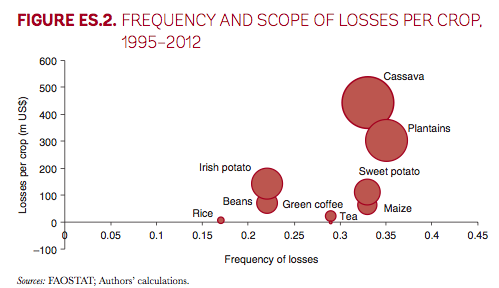 Currently, the crops most exposed to risks are cassava and plantain, followed by fairly evenly distributed losses between Irish potatoes and sweet potatoes. Maize has relatively frequent losses but the losses are not as large as for the first four crops. The scope of the losses are clearly in line with the importance of the crop in the total sector, because cassava, plantain, potatoes, and maize dominate agricultural production in terms of value.