
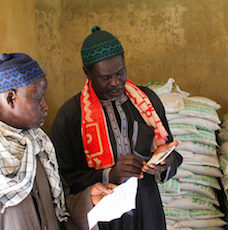

Climate services for Smallholder Farmers featuring Dr. James Hansen, from the International Research Institute for Climate and Society (IRI) at Columbia University
Webinar Topic
Through the ages, farmers have used indigenous knowledge and traditional coping strategies to adapt to changes in weather and climatic conditions. Now, increasingly erratic climate variability is making it difficult for farmers to keep up. Easily accessible and timely scientific information can help societies not only limit the economic and social damage caused by climate-related disasters, but also take advantage of opportunities provided by favorable conditions. Climate services are meant to fill this need. They will ensure that the best available climate science is effectively communicated with agriculture, water, health and other sectors, to develop and evaluate mitigation and adaptation strategies.
>>Download the Presentation
>>View the Webinar
In a variable and changing climate, information may be the key to unlocking successful adaptation strategies. Climate information services are a powerful tool in helping farmers adapt to the impacts of climate variability and change, to both protect against drought and extreme events and take advantage of good conditions. A new report presents lessons learned from 18 case studies across Africa and South Asia that have developed and delivered weather and climate information and related advisory services for smallholder farmers, demonstrating that scaling up these services for millions of farmers is possible today. >> Click on the report to download
About the Presenter
 Dr. James Hansen holds a Ph.D. in Agricultural and Biological Engineering from the University of Florida, and an M.S. in Agronomy and Soil Science and B.S. in General Tropical Agriculture from the University of Hawaii. He has worked on managing climate-related risk for agriculture and food security since 1996 – first at the University of Florida where he was part of the Southeast Climate Consortium, then since 1999 in his present position as a Research Scientist at the International Research Institute for Climate and Society (IRI) at Columbia University.
His current research emphasizes:
- the economics of risk and advance information in agriculture;
- design and communication of climate information for smallholder farmers;
- and modeling interactions between climate and agriculture.
Hansen’s research contributions include valuation of climate information, farm economic risk and sustainability analysis, land use under conflicting goals, spatial scaling in agroecosystem modeling, stochastic weather modeling, climate-informed crop forecasting, tropical soil fertility, and multiple cropping systems ecology.
Questions to the Presenter
1. What are “climate services” and how do they differ from traditional extension services?
A farmer would typically look to his/her agricultural extension service for advice about crop or livestock management practices, and to his/her national meteorological service for weather and climate information. Our work with climate services for farmers seeks to marry the two; integrating quality weather and climate information, with expert guidance about how farm management decisions could be adjusted to better deal with climate variability and the uncertainties of weather. Whether the information is delivered through agricultural extension services or some other channels, there is a growing recognition that climate and agricultural expertise must be brought together, and that the farmers themselves must have a voice in the services, if efforts to develop climate services are to enable smallholder farmers to better manage climate-related risks. This is sometimes referred to as “co-production” of climate services.
2. What are some of the challenges to delivering effective climate services?
Although every place where smallholder farmers struggle to provide secure livelihoods presents its own challenges, there seem to be five general challenges that must be addressed if climate information is to really meet their needs:
- Salience: tailoring content, scale, format and lead time to farm-level decision-making.
- Access: providing timely access to remote rural communities with marginal infrastructure.
- Legitimacy: giving farmers an effective voice in the design and delivery of climate services.
- Equity: ensuring that women, poor and other marginalized groups can access and use available climate services.
- Integration: Providing climate services as part of a comprehensive package of agricultural support and development assistance, enabling farmers to act on climate information.
The success of efforts to provide useful climate-related information to smallholder farmers seems to depend to a large degree on how effectively they address these challenges, and on whether any big challenge is overlooked.
3. Can you highlight some best practices for designing climate services that farmers will value and use?
“Best practice” seems to suggest that we’ve figured out the best way to do things, and simply need to replicate them. I don’t think this area of climate services for farmers has reached the point where we can confidently say that particular practices are always best. But from looking at a number of innovative case studies, CCAFS has identified eight of what we consider “good practices” for addressing the key challenges that I mentioned earlier:
- Develop institutional arrangements that support sustained interaction and co-production of climate services by climate and agricultural institutions, and representatives of farmers.
- Provide climate information and advisories at the local scale at which farmers make decisions.
- Provide a seamless suite of forecast, advisory and early warning products, with a range of lead times, to enable farmers to manage evolving risks through the season.
- Ensure that farmers have an effective voice in the design, production and evaluation of climate services.
- Integration of meteorological information with farmers’ local knowledge to foster trust, local relevance and use.
- Face-to-face dialogue between farmers and service providers is an effective way to communicate historic and predicted seasonal climate information.
- ICT (e.g., mobile phones, rural radio), in combination with other communication channels, offer expanding opportunities to reach farmers with relevant information, at scale.
- Proactive targeting the needs of women and other socially marginalized groups is needed if the most vulnerable within rural communities are to benefit.
4. How can climate services be integrated with other interventions in a comprehensive agricultural risk management strategy?
Because climate services projects or programs are initiated outside of the agriculture sector, this is a widespread challenge. Your first question hints at a good starting point: integrate climate services into existing agricultural extension services. Beyond that, it is important to understand where climate variability and the uncertainty that it causes challenges. This may identify particular opportunities to integrate climate information with other agricultural development interventions. For example:
- Using historic climate data to identify where a particular crop cultivar is adapted, or where a profitable crop commodity could be expanded;
- Incorporating seasonal forecasts into seed and fertilizer recommendations and supply chain planning;
- Manage agricultural pests based on observed and forecast weather conditions; or
- Use weather index-based insurance, supported by high quality historic and monitored weather data, to reduce the risk associated with borrowing money for production inputs such as seen and fertilizers.
Climate services will become truely integrated into agricultural strategy as ministries of agriculture, and public and private institutions that act more locally, learn how to make use of climate information, and take the lead in working with meteorological institutions to develop climate information products and services that meet their priority needs. This brings us back to the “co-production” idea that came up in response to your first question.
Other Ressouces
- Climate services for smallholder farmers