

Logistics Risk Management in Agriculture
Prof. Dr. José Vicente Caixeta Filho, “Luiz de Queiroz” Agricultural College (ESALQ) at the University of São Paulo (USP), BRAZIL
FARMD (January 2013) | In the past decades, one of the most striking phenomena observed in the agricultural economics of developing countries, and in an accelerated way in recent years, is the transformation of their spatial arrangement. Agricultural businesses have occupied new frontier areas, usually through activities combining modern production technologies. Similarly, input suppliers, storage and processing industries have clustered around production zones, focusing especially on minimizing the transportation costs involved.
The basic motivation for such an optimization is the need for augmenting the competitiveness of national products. This has already resulted in a clear reduction of costs in exporting operations.
It has then been assumed that the so called “improved logistics” can contribute to income enhancement in such economies, promoting also inclusiveness, especially of smallholders along agri-food chains.
This type of attempt involves all the actors in the process, starting with the farmers themselves. However, there would be no incentive for them to increase production if they know full well that the extra production will spoil before it can be utilized or sold.
Agri-food chains
Advancing along the agri-food chains, one can be faced with the task of – for instance – transporting food from producers to consumers, which typically consists of moving the raw food products relatively short distances from farms to processing or storage facilities and then moving the processed products from the processing and storage facilities to storage or trading facilities in consuming regions. Therefore, almost all food products must be transported at least twice and, in some cases, more. Few consumers carry more than a few days’ inventories of many perishable products, so interruptions of food shipments could have a quick impact. In addition, long distance transportation requires time, which creates the possibility for food deterioration, shrinkage, and loss during transport.
Hence, for agro-industrial activities, the benefit may arise not only from an increase in production but from a loss avoided. More specifically, better feeder roads or highways, for instance, besides reducing the cost of moving produce from the farm to the consumer, may also minimize the eventual losses due to bad road conditions. The resulting benefit may be distributed among farmers, truckers, and consumers.
The mode of transport utilized can also imply a pattern of energy consumption and of carbon emission, which may or may not be well suited for shipments of certain products or commodities. Trucks, because of their speed and flexibility, may have inherent advantages over rail and barges for certain products, while the low cost of barge shipments makes it attractive to bulk commodities where time is not particularly important. If the transportation mode selected is not the most adequate one, a series of losses can occur.
Examples in Brazil
In Brazil, particularly, there are some very successful cases in which managerial efforts towards “improved logistics” are resulting in clear economic savings.
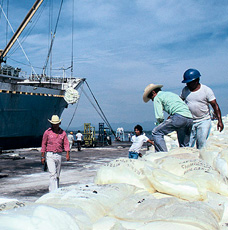
It is remarkable the increased demand for freight to deliver grains, starting in the Center-West region of Brazil (mainly Mato Grosso), which has also provided greater back-hauling opportunities. Especially for the flows of fertilizers, highway carriers are willing to make their way back from the ports up to the interior of the country.
In this context, the agro-industries and traders are the great supporters of this increased flow of export, although not necessarily the only ones to use the still cheaper back-hauling freights. This benefit is available to all companies willing to import and transport their fertilizers to grain producing regions. The formal hiring mechanisms for freight do not require that the same trucks used for export by a given company have to be used by that same company to return to the Center-West region.
Nevertheless, some agro-industries operating with both soybeans and fertilizers – classic examples for a good load-matching operation – will certainly be more likely to minimize their logistics risks. Soybeans are usually moved to ports by trucks, observing a competitive freight price, especially because there is the availability of a good quantity of imported fertilizers around the seaport regions, that should go to producing regions, in a synchronized way and practicing much smaller freight prices (in comparison with the soybean ones), using the same trucks on similar road distances.
Another interesting example of “improved logistics” is producer Johannes Petrus W. de Wit, general manager and owner of Jan de Wit Company, Brazil’s largest producer of Oriental and Asian lily flowers, which has had consistent annual increasing revenues. The firm’s gains resulted from its investment in computerized production planning based on a mathematical model developed especially for its many needs.
Basically, the mathematical model that was developed could transform the optimal sales and production plan into reality, making the proper recommendations to Jan de Wit Company plant the right bulbs during the right week. To make efficient use of its greenhouses, the company must have very strict and accurate planning. It must take into consideration the seasonal pattern of the flower market, with its peaking prices at specific dates, such as Mother’s Day, Easter, All Soul’s Day, and Christmas. Therefore, if it is important for the flower producer to have the right quantities to be sold in those specific dates (when the price is good for the producer and high for the consumer), it is not less relevant to have an optimal plan to occupy the greenhouses in the remaining dates.
Concluding comments
To manage logistics risk in Agriculture does not only mean a new stock of technical knowledge to be shared among the different actors involved in so many agri-food chains. It is also a cultural movement that starts with the basic care in the organization of data sets and also with the specification of adequate models (including the mathematical ones), which will bring good information to support reliable decision making. Should we never forget: garbage in, garbage out…