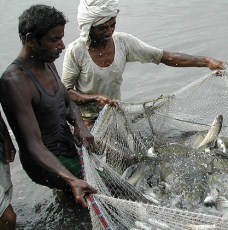


Risk Management for Smallholders in Aquaculture: The Work of Aquaculture without Frontiers
Article By: Roy Palmer, Executive Director, Aquaculture without Borders and Dave Conley, Senior Consultant and Founding Partner of the Aquaculture Communications Group (ACG)
Aquaculture without Frontiers (AwF) is an independent non-profit organization that promotes and supports responsible and sustainable aquaculture to alleviate poverty and hunger. We do this by teaching aquaculture techniques to the rural poor in developing countries, thereby improving their livelihoods.
By teaching the poor to farm fish, we are training them in all aquaculture techniques, thereby assisting them to manage various risks that may arise (i.e., over-stocking, poor technical pond construction, inadequate equipment, incorrect species utilization, diseases, climate change and other natural impacts, husbandry methods, lack of adequate logistics, market fluctuations, etc.).
One of the most useful resources we have found in our work has been the use of ‘Farmer to Farmer’ training programs. These activities have proven to be a sound model for us which, with the great assistance of sponsors, enables us to send experienced, skilled and knowledgeable aquaculture farmers from developed countries to engage with the people we are trying to assist in developing countries. This is a double win because as well as passing on their invaluable skills, there is an enormous sense of well-being for the training ‘Farmer’ knowing that he/she has been of assistance to someone who will be able to use the skills gained well into the future – the work can make an enormous difference.
Case Study: Bangladesh
The word ‘Monga’ refers to the twice yearly cyclical phenomenon of poverty and hunger that occurs in Bangladesh. Monga happens from September-November (after the main crops are planted) and from March-April. During these times there are fewer available job opportunities for rural workers, resulting in the workers being forced to become migrants and move to more urban areas. Those who cannot migrate can face malnutrition and starvation, as has been cited in Bangladesh’s Poverty Reduction Strategy Paper, and has been the subject of NGO aid programs
Our project covered a total of 111 participants over a 4 year period – all from farms considered marginal at the time. The third year started with 89 farmers in the system, all of whom continued into the fourth year, and they were joined by 22 new farmers for the last year. The main aim was to increase production and provide a sustainable training model. The training is essentially a risk management process as all of the issues it addressed are strategies for various deficiencies that create reduced production and inefficiencies.
The new farmers were oriented on fish culture through pond on-site training. Farmers are trained on pond preparation, liming, fertilization, feeding, fingerling conditioning, sampling etc. Older farmers also get refreshers by training at the pond site, so that they can also learn about best practice in fish culture. The local Fishery Officers from the Government of Bangladesh also extended support during pond site training and refresher courses. Their participation helped create shared experiences which can be beneficial for future capacity building.
It was discovered during the project that traditional stocking practice allowed for an excess number of fingerlings without maintaining a species combination. The fingerling trader often persuades the pond farmers to over indulge in huge stocking – this is good for the trader as he pockets the extra money for the extra fingerlings sold but can be a disaster for the pond and fish, as getting the stocking density wrong can be a critical factor in the whole production process that can have devastating effects.
The project specifically managed the risks of improper pond preparation, improper feeding and fertilization, misunderstanding about sampling in order to adjust production strategies, lack of knowledge regarding annual production cycles, over-stocking and lack of species diversity in ponds. This knowledge is critical for farmers to build sustainability and ensure food security going forward.
The funds that were distributed to the project participants were used for purchasing fingerlings, lime, feed and fertilizer. The volunteer farmers assisted the project participants by ensuring that they were educated on maintaining quality of the inputs.
In addition to farmers, four fingerling producers were developed through the project and they were assisted and advised to rear over-wintering fingerlings. It is notable that in the finalyear of the project production had increased to approximately 6100 kg of fingerlings which were sold to the local grow-out and project farmers.
The pond farmers themselves were taught to stock large size over-wintering fingerlings as it promotes good growth. This business develops the farmers into good aquaculture entrepreneurs that then scale up the project and add value by sharing their newly acquired knowledge with othersand by working as local extension operators.
Project Impact
The farmers that engaged in aquaculture were able to cope with Monga by selling fish during those times. Fish culture helped as a source of income when no other alternative source was available. The household fish consumption especially for the children comes from their own pond where saved money enabled them to purchase items from the market. About 82% of farmers from the area were involved with pond cultivation and they continued to produce a range of local vegetables, most of which were used for family consumption with the balance sold in the market to earn money.
An added bonus is that fish intake by the families involved with this project significantly increased. The rural poor farming family normally cannot afford to eat fish regularly every week. During the project it was shown that the average fish consumption during the reporting period by those families involved rose to 33.4 kg (current world average is about 18kgs). Their neighbors had also increased their purchasing of fish during harvesting time due to the improved availability. Women and children were encouraged to participate in fish culture activities and this improved the family’s engagement.
Conclusion
The conclusion of the project highlighted that aquaculture can play a vital role in the life of the rural poor through utilization of small ponds, which are sources of income and food for marginal farming families. The families engaged directly in the project obtained a major source of nutrition from consuming the fish, an effect which expanded to positively impact their neighbours as well. This all created confidence towards aquaculture and by developing the risk mitigation strategies and capacity building through strong linkages the project, also created a sustainable approach for aquaculture.
More information about Aquaculture without Borders
Aquaculture without Frontiers Principles:
- Provides technical and managerial experience from individuals in the existing aquaculture community, utilizing all age strata, from students to retirees, as appropriate.
- Supports responsible and sustainable aquaculture practices.
- Pays special attention to forms of aquaculture (and associated activities) that have the potential to alleviate poverty and improve health through the provision of ‘home-grown’ food and the enhancement of livelihoods.
- Recognises and supports the role that women play in aquaculture and linked activities.
- Ensures that its activities are targeted at benefiting ‘grass-root’ farmers and SMEs.
- Is culturally sensitive, and non-discriminatory and non-aligned in religion and politics.
- Carries out projects that are carefully monitored and assessed for efficacy.
- Is transparent and accountable in its work.
AwF has been established as an independent ‘stand-alone’ NGO, although one of its key principles will be to assist existing NGOs, which have a wealth of experience in developing countries. Cooperation need not necessarily be confined to NGOs that already include aquaculture in their portfolio of project work; those that use common resources will also be targeted.
Contact
Roy D Palmer, Executive Director, Aquaculture without Frontiers http://www.aquaculturewithoutfrontiers.org/
Skype: seafoodhealth
Tel: +61419528733
Email: [email protected]