
Major Pest & Diseases of Cocoa: Symptoms
Jump to: Pests
Diseases:
Pod Rot / Black Pod: Obvious symptoms are the rotting or necrosis of pods. Pods can be attacked at any stage of development, and the initial symptoms are small, hard, dark spots on any part of the pod. Internal tissues, including the beans, are colonized and shrivel to form a mummified pod. (Source: ICCO)
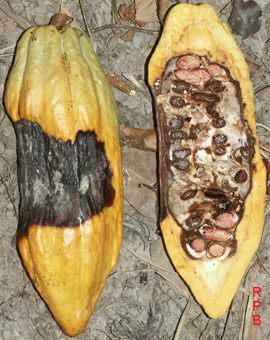 Witches' Broom: The fungus attacks only actively growing tissue (shoots, flowers and pods) causing cocoa trees to produce branches with no fruit and ineffective leaves. The pods show distortion and present green patches that give the appearance of uneven ripening. (Source: ICCO; image: dropdata)
Frosty pod Rot: The fungus infects only actively growing pod tissues, especially young pods. The time from infection to the appearance of symptoms is about 1-3 months. The most outstanding symptom is the white fungal mat on the pod surface. (Source: ICCO)
Charcoal Pod Rot: The disease occurs on wounded pods or pods which are" under stress. The infection takes place through wounds generally caused by insects and rodents. The infection appears as dark brown to black spot on any place on the pod surface and spreads rapidly. The whole mass of the pod including the beans becomes black in colour. If the infection occurs in the early stages of pod development, the beans may not develop fully and get mummified. Charcoal pod rot is found throughout the year. But the disease is severe during summer months. (Source: Chandalinga)
Seedling Die Back: This disease is more severe on one to four months old seedlings. Infection may start from the tip of the stem or from cotyledonary stalk or from the collar region. The disease appears as dark brown to black, water soaked, linear lesions. This lesions extend to the leaves through petiole result in wilting and subsequent defoliation of the seedlings. In advanced stage die back of the seedlings. (Source: Chandalinga)
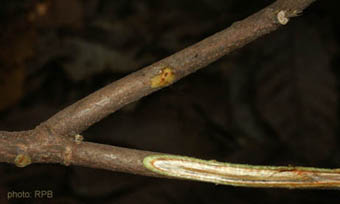 Vascular-streak dieback (VSD): The initial characteristic symptoms are the chlorosis of one leaf on the second or third flush behind the tip. The fungus may spread internally to other branches or the trunk, usually causing death of the tree. When an infected leaf falls during the rainy season, hyphea may emerge from the leaf scar and develop into a basidiocarp, evident as a white, flat, velvety coating over the leaf scar and adjacent bark. (Source: ICCO; Image: dropdata)
White Thread Blight: The young branches of the affected plants contain white mycelial threads of the fungus which spread longitudinally and irregularly along the surface of the stem. The growth of the fungus is very rapid on the stem under favourable conditions of high humidity and entered the leaf at the nodes along the petioles. The fungus invades the cortical tissues which eventually turn dark brown to black. The diseased leaves also turn dark brown. The dead leaves in a branch eventually get detached from the stem but are found suspended by the mycelial thread in a row. The extensive death of the young branches and suspended leaves in rows are the common field symptoms of white thread blight. (Source: Chandalinga)
Pests:
Mirds: Cocoa mirids pierce the surface of cocoa stems, branches and pods, killing the penetrated host cells and producing unsightly necrotic lesions. Mirids feeding on shoots often result in the death of terminal branches and leaves, causing dieback. Mated female mirids lay up to 60 eggs that are embedded in the bark of stems or inside the pod husk. Pests usually occur on trees exposed to sunlight since such trees tend to bear more fresh shoots and pods. Although the insect is attracted to trees exposed to sunlight, after locating their source of food they inhabit shady areas on trees. Some indigenous plants grown with cocoa have been identified as alternative hosts for some species of mirids. (Source: ICCO)
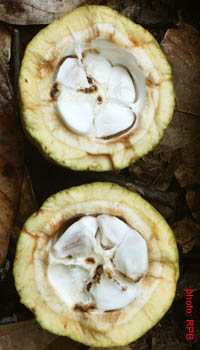 Cocoa pod borer (CPB): CPB attacks both young and mature cocoa pods. A common symptom of infested pods is unevenness and premature ripening. Infestation of young pods results in heavy losses because the quantity and quality of the bean becomes seriously affected. A CPB moth is 7mm long and brown in colour with a white strip on the forewings. The female lives for about 5-7 days and lays 100-200 eggs on the surface of the cocoa pod. The larval period is about 14-18 days, then 5-8 days before hatching as a moth. (Source: ICCO, image: dropdata)
Ring Bark Borers: Phassus hosei and P. sericeus are ring bark borers. They damage the bark around the stem. They attack both young and old trees. Drenching 1 per cent dieldrin into the holes and sealing them can control the pest. (Source: Chandalinga)
Thrips: The most abundant species of thrip that attack cocoa is Selenothrips rubrocinctus. They infect lower leaf surfaces. The sap sucking results in leaf shriveling. The population is found to increase with soil stress conditions. The use of drought tolerant types can control the thrips. However, chemical control with spray is also possible. (Source: Chandalinga)
Cocoa Beetle: The longhorn beetle, Steirastoma breve, is a pest of cocoa in many countries. Eggs are laid in holes in the bark. The larvae bore a chamber in the cambium and bark. From the chamber a tunnel is bored in a spiral, which often rings the stem so that it dies. A pupal chamber is then bored in the heart wood, weakening the stem. A gummy, gelatinous exudate appears around holes through the bark made by larvae. Trees from 6 months to 5 years are attacked. The intensity of attack increases as the amount of shade is reduced. (Source: Chandalinga)
Learn More about cocoa pests & diseases at International Cocoa Organization (ICCO), as well as the dropdata and the Queensland Government websites.