
Logistics Risk in Agriculture
This FARMD Featured Topic highlights logistics risk in the agriculture sector and some possible risk management options. Logistics risks impact actors throughout the supply chain, ranging from producers and government to traders, processors, and grocery stores. Because of this far reaching impact, incorporating the improved management of logistics risks is critical to a holistic agricultural risk management strategy. Explore this section by reading the original articles below, joining a discussion, finding documents related to logistics risk management, discovering new resources, and viewing the latest news articles on this topic.
Featured Article | Managing Logistics Risks in Agricultural Supply Chains Along International CorridorsJean Francois Arvis, Ian Gillson and Charles Kunaka, The World Bank FARMD (January 2013) | Agricultural production is synonymous with uncertainty often by virtue of its exposure to weather; the unpredictability of disease and pests; and, the seasonality of harvest and market cycles. Agriculture is also dependent on supply chains to cope with the geographical separation of inputs, farming and consumption. Agricultural supply chains comprise input supply (seeds, fertilizer, energy), production, post-harvest, storage, processing, marketing and distribution. These elements along the ‘farm-to-fork’ supply chain increasingly span national borders and involve inputs from a wide range of public and private sector participants. These participants typically support three major types of flows in the supply chain, namely: i) physical products (from input suppliers to farmers, farmers to traders, traders to buyers, buyers to consumers); ii) financial (credit, payments, insurance); and, iii) information (prices, transport opportunities). Logistics are a critical part of these flows, and weaknesses in them are often a major source of risk in agricultural supply chains that affect the availability, timing, traceability and quality of goods. Until recently food supply performance was primarily understood in terms of transportation costs for inputs and outputs. Today the complexity of supply chains is more fully recognized and its performance also assessed in terms of reliability. |
Contributors:
|
The owner of the goods being transported has a legal duty of care towards said goods. In practice, this has meant that agricultural products such as coffee, cocoa, rice and other commodities that have to be transported over long distances often suffer risks that lead to quality deterioration and ultimately large claims to the cargo companies...Read More |
| Prof. Dr. José Vicente Caixeta Filho, “Luiz de Queiroz” Agricultural College (ESALQ) at the University of São Paulo (USP), Brazil | In the past decades, one of the most striking phenomena observed in the agricultural economics of developing countries, and in an accelerated way in recent years, is the transformation of their spatial arrangement. Agricultural businesses have occupied new frontier areas, usually through activities combining modern production technologies. Similarly, input suppliers, storage and processing industries have clustered around production zones, focusing especially on minimizing the transportation costs involved...Read More |
|
Techane Bosona, Swedish University of Agricultural Sciences-SLU, Uppsala | Worldwide, the distance and tonnage of food shipment have increased during the past decades. For example, the distance food travelled at the beginning of 21st century had increased by 50% in UK and by 25% in USA from what it travelled in the 1980s (Halweil, 2002). The increase in food transport not only has negative impact on logistics cost and environment but also has increased risk for food quality, safety, security, and traceability...Read More |
|
Dr. Paul T. Kidd, Cheshire Henbury, United Kingdom | In a world where fresh produce such as fruit and vegetables is regularly shipped using road, rail, sea, and air transport, often over long distances, increasingly across international borders, and in some circumstances, from one continent to another, it is natural to ask what can be done to reduce the risk of quality losses that are an inevitable part of such transportation. With Information and Communication Technologies (ICT) becoming increasingly ubiquitous, it is also natural to ask if these technologies might be used in some way to reduce the risk of quality losses...Read More |

Additional Resources & Recommended Websites
- CargoHandbook.com | This website provides information on over 750 commodities with emphasis on those characteristics which may be relevant during overseas transportation.
- Decoding Sustainable Logistics Trends - Viewpoints from leading practitioners | Presentations from this June 2012 World Bank hosted event.
- World Bank Logistics Performance Index | Based on a worldwide survey of operators on the ground -- such as global freight forwarders and express carriers -- the Logistics Performance Index (LPI) measures the logistics "friendliness" of 155 countries. It helps countries identify the challenges and opportunities they face in their trade logistics performance and what they can do to improve.
Related Video:
|
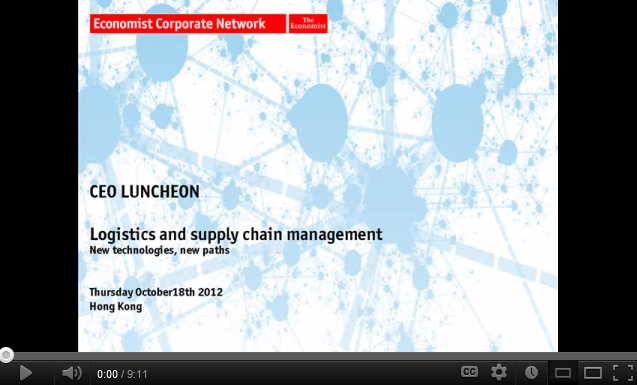
The Economist Corporate Network (October 2012) | Ross O'Brien, Director of the Economist Corporate Network in Hong Kong spoke to Johann Poppenbeck, VP Product Management at DSI on the evolving role of data and technology management strategies in the logistics and supply chain industry. Watch Now |
Global Student Forum 2012 (June 2012) | Who's benefiting - and who is losing out - in the global supply chains that put food on our supermarket shelves and ultimately on our plates? How do these supply chains impact upon poverty and hunger? What is the role of supermarkets and consumers... Watch Now |