
Geospatial Data & Mapping for Agriculture Risk Management
Geospatial Basics:
Why is Geospatial Important to Agriculture Development?
Carlos Arce of the World Bank shares his thoughts on the uses and importance of geospatial technologies in sustainable agriculture development. Watch More Videos

In this Featured Topic, FARMD features a number of highly informative and interesting articles examining how geospatial data is being used to improve management of agricultural risks across the developing world. The featured article by Dr. Nathan Torbick from Applied Geosolutions illustrates how geospatial data combined with innovative analysis is being utilized by the international development community to provide relevant and timely information to key decision makers, enabling them to better prepare for the occurrence of agricultural risks. Collaboration between private, public and third sector organizations is leading to striking developments that offer significant opportunities for improved risk management at micro, meso and macro levels.
Latest Addition:
Great new sites from the CGIAR using geospaital data for agriculture:
- RTB Maps (CIAT) | Roots, Tubers, and Bananas (RTB) Maps contains geographic information on crop distribution, harvested area and yield, as well as crop specific agroecological zones and biophysical maps related to each RTB crop.
- Arab Spatial (IFPRI) | Arab Spatial is an online information storehouse that aggregates food security and development information from the region’s governments as well as international institutions. The tool displays the data on maps that users can zoom in on to the regional, national, sub-national, and even the pixel level. Users can then build and print their own maps overlaid with information of their choosing.
- HarvestChoice Mappr (HarvestChoice) | HarvestChoice generates knowledge products to help guide strategic investments to improve the well-being of poor people in sub-Saharan Africa through more productive and profitable farming.
Featured Article: Geospatial Data and Weather Risk Mapping for Agriculture Risk Management
Dr. Nathan Torbick - Applied GeoSolutions
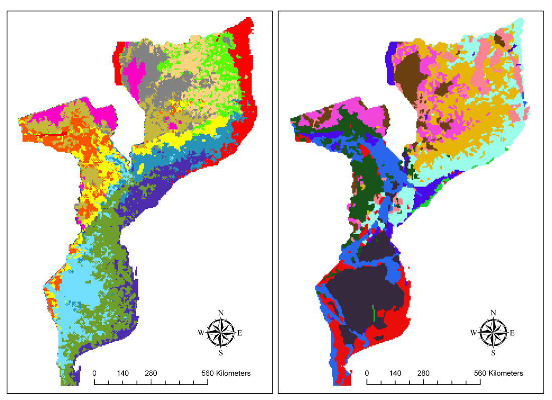 Many regions experience shocks of severe weather variability and inter-seasonal volatility that affect cash crops, food security, and consequently damage livelihoods. Droughts; floods; extreme temperatures; changes in disease ranges; and the shifting timing of rain patterns are just a few of the risks agriculturalists face across the globe. In poorer countries these stressors can often cause significant hardships due to the strong socioeconomic dependency on agricultural production. All the while threats from weather variability are predicted to become more extreme due to climate change (higher impact and greater frequency). To address significant agricultural weather risk, stakeholders need more targeted geospatial decision support tools at appropriate scales for risk assessment, adaptation, and mitigation planning. The quality of these tools will largely be influenced by the availability and resolution of geospatial data, and the ability to put the data into easily accessible systems which can be utilized in an effective manner by actors in developing countries. Exciting developments are already underway showing how complicated data can, when made accessible, be used to greatly inform and improve agricultural risk management programs and strategies.
Read the Article
All Articles
This month's contributors come from across the world and the field of geospatial data for agricultural risk management. Each contributor has submitted a unique and interesting article, please use the links below to view each article and leave comments:
Latest Article
|
 Jim Bauman, Esri Writer
| Ben Stuart and Elizabeth Gibbens, The World Bank. FARMD (May 2012) | From location-aware mobile tools to satellite imagery to GPS driving directions, web users everywhere are exposed to geospatial data every day. People are excited about what this data can do for them—at least on a personal level. In the developed world, many do not have to fear getting lost in a new city. But what is geospatial data, this newly ubiquitous information? “Geospatial data” refers to any information that can be associated with a particular location on the Earth’s surface. Read the Article |
 Nick Kouchoukos and Corey Cherr, Global Head of Agricultural and Forestry Research at Thompson Reuters Lanworth with Corey Cherr conclude that daily, global satellite imagery, improved long-range weather projections, and biologically realistic crop growth and yield models offer powerful new means to exceed the limits of conventional forecast methods.Read the article. Nick Kouchoukos and Corey Cherr, Global Head of Agricultural and Forestry Research at Thompson Reuters Lanworth with Corey Cherr conclude that daily, global satellite imagery, improved long-range weather projections, and biologically realistic crop growth and yield models offer powerful new means to exceed the limits of conventional forecast methods.Read the article. |
 Kees Van 't Klooster and Claire Jacobs. The authors argue that geospatial data has the opportunity to revolutionize African agricultural by enabling the introduction of widespread precision farming, through improved planning, weather risk mapping and operational utilization of the data. Read this article Kees Van 't Klooster and Claire Jacobs. The authors argue that geospatial data has the opportunity to revolutionize African agricultural by enabling the introduction of widespread precision farming, through improved planning, weather risk mapping and operational utilization of the data. Read this article |

Andries Rosema, General Director, EARS General Director, EARS highlights EARS' work in the FESA insurance project. He describes how their innovative work in relative envirotranspiration has been used as a geospatial analysis tool for agriculture risk management. Read the article |
 Dan Osgood, Lead Scientist, Financial Instruments Sector Team focuses on the uses of geospatial data in index-based insurance programs in developing countries. He looks at how satellites can potentially overcome "data poverty" where historic and current weather data may be lacking, a common problem in many developing countries. Dr Osgood notes that Index Insurance can not be scalable if it only works in areas covered by existing rain gauges, with accurate and long term historical weather data. Read the article Dan Osgood, Lead Scientist, Financial Instruments Sector Team focuses on the uses of geospatial data in index-based insurance programs in developing countries. He looks at how satellites can potentially overcome "data poverty" where historic and current weather data may be lacking, a common problem in many developing countries. Dr Osgood notes that Index Insurance can not be scalable if it only works in areas covered by existing rain gauges, with accurate and long term historical weather data. Read the article |

Carlos Arce, Senior Economist, The World Bank. Carlos Arce argues that although geospatial data applications are without a doubt heading in the right direction, the greatest challenge facing this field is to simplify the complexity of these models to ensure their usability is maximized, and to adapt the analysis to the context of decision making in developing countries. Read the article |
 Dr. Nathan Moore Dr. Nathan Moorediscusses the increasing challenges ahead for the agriculture sector due to climate change. He asserts that agricultural risk management requires better short-term forecasts, better communication between stakeholders and scientists, and consistent, reliable on-the-ground data, if we are to develop more resilient, food-secure systems in East Africa and elsewhere. Read the article |

James Verdin, International Program Manager, United States Geological Survey | Jim Verdin details the uses of and partnerships between the FEWS NET system and the USGS in geospatial analysis inWater Requirement Satisfaction Indexing (WRSI), land surface temperature and climate forcasting. Read the article |
Resource Library
Looking for publications and resources related to this featured topic? Check the FARMD Library of resources.
Organization Profiles:
Find organizations working in this field in the FARMD Practitioner's Directory.
Active Projects Using Geospatial Tools
- CCAFS Adaptation and Mitigation Knowledge Network (AMKN)
- CGIAR-CSI
- Harvest Choice – new Ag MarketFinder
- CIAT:
- Drought Timing for Agronomic Screening
- Direct Link to Drought Timing for Agronomic Screening Map
- Global Agricultural Trial Repository
- Direct Link to Map
- MAPAZ:
- Direct Link to Map
- Drought Timing for Agronomic Screening